domingo, 5 de diciembre de 2010

All U.S. embassies and consulates around the world spying on host nation citizens

By Wayne Madsen
Online Journal Contributing Writer


Nov 19, 2010, 00:18


(WMR) -- With revelations that U.S. embassies in Oslo, Copenhagen, and Stockholm have carried out spying operations against the host citizens of Norway, Denmark, and Sweden from the respective embassies, comes news to WMR that the system carrying out the secret surveillance -- the Security Incident Management Analysis System or SIMAS -- not only also spies on citizens of the two Nordic partners of Norway, Denmark, and Sweden, namely Iceland and Finland, from U.S. embassies in Reykjavik and Helsinki, respectively, but spies on individuals from all U.S. embassies and consulates around the world -- from Santiago, Chile, and Canberra, Australia, to Bishkek, Kyrgyzstan, to Maputo, Mozambique.

The Finnish paper, Helsingin Sanomat, is reporting that the Finnish Security Police (SUPO) has asked U.S. authorities about the activities of SIMAS in Helsinki. One nation that has adopted a sanguine reaction to the U.S. embassy spy program is Denmark, described by one intelligence insider as a “zone of control” for U.S. surveillance activities in Scandinavia. The cooperation between the U.S. and Denmark in surveillance operations began under Prime Minister Anders Fogh Rasmussen and it was one of the reasons he was rewarded by Washington with the job of Secretary General of NATO.

The Norwegian and Swedish governments have demanded answers to questions from U.S. authorities about SIMAS spying but State Department spokesman P. J. Crowley, a retired Air Force colonel who has historically been assigned by the CIA to oversee the Clintons, whether at the White House or, now, at the State Department, claimed that the government of Norway had been informed by the United States of SIMAS surveillance from a Surveillance Detection Unit (SDU) located in a building near the U.S. embassy in Oslo.

On November 4, Crowley was asked at a State Department press conference about his earlier statement that Norway had been informed about SIMAS. The question and answer session:

“Q . . . on Monday when I asked you, you said that the Norwegian Government was aware of these activities. They say they are not. So who’s lying here?”

A. “I’m, we, the security of our Embassy involves cooperation between our security officials and Norwegian security officials. Ill just stand by those words.”

Q. “But why have you hired a building outside Norwegian your Embassy in Norway, in Oslo, and filled it with Norwegian police officers and also Norwegian military officers?”

A. “That’s a better question to ask our Embassy. I haven’t been there in a while, so I can’t provide you any insight.”

Q. “But just to follow up. But both the State Department in Norway and also the Justice Department in Norway said they’re not aware that you have some activities outside your Embassy building. Why haven’t you informed the Norwegian Government?”

A. “Well, look, embassy diplomatic posts all over the world are ripe targets for a terrorist attack, whether they’re U.S. embassies, whether they are the embassies of other governments. It is right and proper that we would take appropriate steps to protect our diplomatic posts anywhere around the world, and we would expect any government to do the same, whether its somewhere over out overseas or here in the United States. So we have a program where we look carefully to make to evaluate if we believe our Embassy is under observation and potentially under threat. We share that information across the United States Government. But as appropriate, we share that information with our host government partners. The essence of addressing this challenge which confronts the United States and other countries in the West is the very kind of intelligence cooperation and law enforcement cooperation that has been a hallmark of our alliances for a number of years. So how much the host nation government knows about specific activities, I can’t say. But everything that we do is fully consistent with our security arrangements that we have with any host nation government anywhere in the world, including Norway.”

Q. “Can I just follow up? Is there written agreements about this --”

A. “I can’t say. At this point, I would just defer further questions back to our Embassy in Norway.”

Media reports that U.S. embassy spying on civilians has been going on for the past 10 years, since 2000. A State Department Privacy Impact Assessment (PIA) submitted on January 5, 2010, states “The Security Incident Management and Analysis System (SIMAS) is a worldwide Bureau of Diplomatic Security (DS) web-based application, which serves as a repository for all suspicious activity and crime reporting from U.S. Diplomatic Missions abroad (all U.S. embassies and consulates). Department of State personnel, including Diplomatic Security personnel, regional security officers, and cleared foreign nationals, enter Suspicious Activity Reports (SARs) into SIMAS as a central repository for all physical security incidents overseas. SIMAS Reports typically contain a detailed narrative description of the suspicious activity prompting the report, available suspicious person(s) and vehicle descriptors, and other identification data as may be available (e.g. photographs). Reports also indicate date, time and location of suspicious activity, and may include amplifying comments from relevant Bureau offices.”

In other words, SIMAS is global and, in some cases, cleared nationals of foreign nations have access to the SIMAS system. The State Department was recruiting local foreign nationals to work with SIMAS in Accra, Ghana; Bujumbura, Burundi; and Sydney, Australia. Even U.S. citizens abroad are subjected to being subjected to spying by SIMAS. The PIA also states: “SIMAS collects and maintains the following types of PII [personally-identifiable information]on members of the public, foreign nationals, U.S. government employees, and contractors who are identified as being directly or indirectly involved in or associated with suspicious activities and/or criminal allegations near USG property. All types of information may not be collected on each specific group of individuals. However, it may be possible for all forms of PII to be collected on an individual.”

Translating the government gobbledy-gook language, while SIMAS is not authorized to collect certain types of data on groups or individuals, when it comes to each individual, anything is fair game.

At the very least, SIMAS contains data on: gender, race, height, weight, eye color, skin tone, hair color, hair style, images, age or estimated age, body type (build), scars, marks, tattoos, name, address, date of birth, telephone number, father’s name, and mother’s name, citizenship status and Information.

SIMAS data is also shared with the Central Intelligence Agency, Department of Homeland Security, Federal Bureau of Investigation, Department of Justice, Department of Agriculture, Department of Treasury, Department of Defense (including the National Security Agency), National Geospatial-Intelligence Agency, Department of Energy, Nuclear Regulatory Commission, Department of Health and Human Services, the Capitol Police, and all other US embassies and consulates around the world.

Although the PIA states that SIMAS data is retained by the Diplomatic Security Bureau according to a set retention schedule and is not shared for purposes other than crime and terrorism prevention, the same cannot be said for the other agencies that access and retain SIMAS data, including the CIA, FBI, and NSA.

The State Department PIA concludes that “SIMAS has been designed to minimize risk to privacy data.” That is hard to believe considering the global access permitted to the system, as well as the fact that not only do a dozen or more U.S. agencies have access to the data but so also do foreign nationals.

So, if you are in Winnipeg or Warsaw, Lusaka or Lisbon, or Malabo or Paramaribo, and you stroll past the U.S. embassy or consulate, “smile, you’re on clandestine camera and now in the SIMAS database.”

Previously published in the Wayne Madsen Report.

Copyright © 2010 WayneMadenReport.com

Wayne Madsen is a Washington, DC-based investigative journalist and nationally-distributed columnist. He is the editor and publisher of theWayne Madsen Report (subscription required).

jueves, 2 de diciembre de 2010

EXCLUSIVE: Controversial Drug Given to All Guantanamo Detainees Akin to "Pharmacologic Waterboarding"

Wednesday 01 December 2010

by: Jason Leopold and Jeffrey Kaye, t r u t h o u t | Investigative Report

The Defense Department forced all "war on terror" detainees at the Guantanamo Bay prison to take a high dosage of a controversial antimalarial drug, mefloquine, an act that an Army public health physician called "pharmacologic waterboarding."

The US military administered the drug despite Pentagon knowledge that mefloquine caused severe neuropsychiatric side effects, including suicidal thoughts, hallucinations and anxiety. The drug was used on the prisoners whether they had malaria or not.

The revelation, which has not been previously reported, was buried in documents publicly released by the Defense Department (DoD) two years ago as part of the government's investigation into the June 2006 deaths of three Guantanamo detainees.

Army Staff Sgt. Joe Hickman, who was stationed at Guantanamo at the time of the suicides in 2006, and has presented evidence that demonstrates the three detainees could not have died by hanging themselves, noticed in the detainees' medical files that they were given mefloquine. Hickman has been investigating the circumstances behind the detainees' deaths for nearly four years.

Interviews with mefloquine and malaria experts and a review of peer-reviewed journals and government documents show there were no preexisting cases where mefloquine was ever prescribed for mass presumptive treatment of malaria.

All detainees arriving at Guantanamo in January 2002 were first given a treatment dosage of 1,250 mg of mefloquine, before laboratory tests were conducted to determine if they actually had the disease, according to a section of the DoD documents entitled "Standard Inprocessing Orders For Detainees." The 1,250 mg dosage is what would be given if the detainees actually had malaria. That dosage is five times higher than the prophylactic dose given to individauls to prevent the disease.

Maj. Remington Nevin, an Army public health physician, who formerly worked at the Armed Forces Health Surveillance Center and has written extensively about mefloquine, said in an interview the use of mefloquine "in this manner ... is, at best, an egregious malpractice."

The government has exposed detainees "to unacceptably high risks of potentially severe neuropsychiatric side effects, including seizures, intense vertigo, hallucinations, paranoid delusions, aggression, panic, anxiety, severe insomnia, and thoughts of suicide," said Nevin, who was not speaking in an official capacity, but offering opinions as a board-certified, preventive medicine physician. "These side effects could be as severe as those intended through the application of 'enhanced interrogation techniques.'"

Mefloquine is also known by its brand name Lariam. It was researched by the US Army in the 1970s and licensed by the Food and Drug Administration in 1989. Since its introduction, it has been directly linked to serious adverse effects, including depression, anxiety, panic attacks, confusion, hallucinations, bizarre dreams, nausea, vomiting, sores and homicidal and suicidal thoughts. It belongs to a class of drugs known as quinolines, which were part of a 1956 human experiment study to investigate "toxic cerebral states," as part of the CIA's MKULTRA mind-control program.

The Army tapped the Walter Reed Army Institute of Research (WRAIR) to develop mefloquine and it was later licensed to the Swiss pharmaceutical company F. Hoffman-La Roche. The first human trials of mefloquine were conducted in the mid-1970s on prisoners, who were deliberately inoculated with malaria at Stateville Correctional prison near Joliet, Illinois, the site of controversial antimalarial experimentation in the early 1940s.

The drug was administered to Guantanamo detainees without regard for their medical or psychological history, despite its considerable risk of exacerbating pre-existing conditions. Mefloquine is also known to have serious side effects among individuals under treatment for depression or other serious mental health disorders, which numerous detainees were said to have been treated for, according to their attorneys and published reports.

In 2002, when the prison was established and mefloquine first administered, there were dozens of suicide attempts at Guantanamo. That same year, the DoD stopped reporting attempted suicides.

By February 2002, there were at least 459 detainees imprisoned at Guantanamo. In March of that year, according to the book "Saving Grace at Guantanamo Bay: A Memoir of a Citizen Warrior" by Montgomery Granger, "the situation" at the prison began "deteriorating rapidly."

"There is more and more psychosis becoming evident in detainees ...," wrote Granger, an Army Reserve major and medic who was stationed at Guantanamo in 2002. "We already have probably a dozen or so detainees who are psychiatric cases. The number is growing."

"Presumptively Treating" Malaria

Continue reading : http://www.truth-out.org/

lunes, 29 de noviembre de 2010

North Korea: Who Sank the Cheonan? The sinking of the US submarine was not reported

by Tanaka Sakai

Global Research, November 27, 2010
Asia Pacific Journal - 2010-05-24

Editor's note

This article by investigative reporter Tanaka Sakai points to the possibility of friendly fire between two vessels.

"But around the time of this incident another sinking occurred that has hardly been reported in Japan. Near the site of the sinking of the Cheonan, a colossal object, which appears to be a US submarine, was found to have sunk. An ROK underwater team searched for, and on April 7 South Korea’s KBS TV showed, a US helicopter carrying what seems to be the body of a US soldier. KBS is a public broadcasting station with the highest credibility in South Korea."

Since this report was published, US Submarine Columbia has returned to Hawaii.

"ROK and US authorities did their best to hide the fact that a US submarine sank at about the same time as the Cheonan.... On the day of the incident, the exercise was underway. After the incident, the US-ROK authorities made no mention of the fact that the joint military exercise was in progress. But the day after the incident, various ROK media and newspapers reported that the Cheonan might have been sunk by friendly fire during the military exercise."

Michel Chossudovsky, November 27, 2010

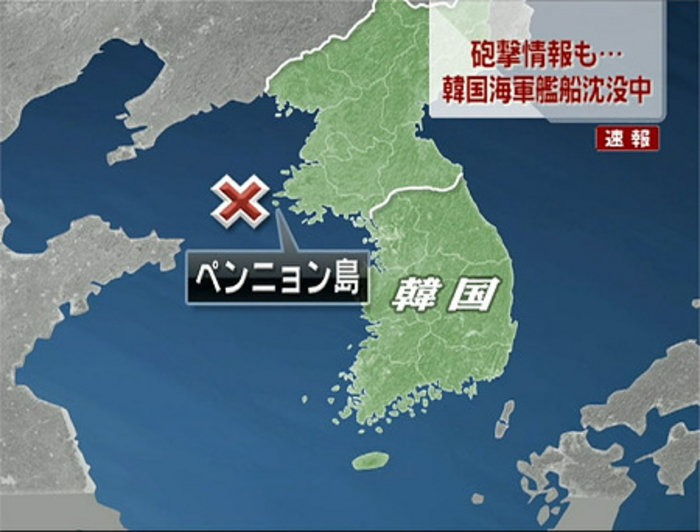
On 26 March, 2010 near Baengnyeong Island (White Wing, also known as Baekreong) to the South of the northern limit line, the maritime demarcation line between South and North Korea, South Korea’s large patrol boat Cheonan (Heaven’s Peace) exploded and sank. Already, more than one month after the accident, the cause of the sinking has not been confirmed. In early April, the South Korean government announced that either a torpedo struck or an underwater mine exploded, sinking the ship, indicating that it was not destroyed by an explosion or accident inside the boat but by an external cause.
The stern of the Cheonan docked on a barge off Baengnyeong Island on 7 May, 2010. Lee Jung-hoon.

However, it remains an enigma as to who fired or set off a torpedo or underwater mine. The South Korean right, claiming that a North Korean semi-submersible ship fired a torpedo, demands that the South Korean government launch a revenge attack on the North. The left and pacifists in the South suggest that the warship may have touched off an underwater mine installed in the 1970s by the South Korean military to prevent North Korean infiltration and still left there.

136 underwater mines were installed in response to the tensions in the Yellow Sea and, ten years later, fewer than ten percent had been removed

Baengnyeong Island is only 20 kilometers from North Korea in an area that the North claims as its maritime territory, except for the South Korean territorial sea around the island. At present there are two demarcation lines on the sea. South Korea and the US (UN) claim that the Northern Limit Line (NLL), which runs just north of Baengnyeong Island, is the demarcation line between North and South. However, since 1999, North Korea has claimed that the Military Demarcation Line further south is the border between North and South. About 5,000 South Koreans live on Baengnyeong Island and regular ferries link it from Inchon. In the reconciliation between North and South in the year 2000, North Korea recognized this ferry route and the sea around the island as an area where South Korean and American boats can navigate freely. At the same time, North Korea has regarded American and South Korean boats entering the sea area beyond that as violating the economic zone of North Korea.

Map of Baengnyeong Island (1)

Map of Baengnyeong Island (2)

In the vicinity of Baengnyeong Island South Korea constantly confronts the North Korean military. The Cheonan was a patrol boat whose mission was to survey with radar and sonar the enemy’s submarines, torpedoes, and aircraft, and to attack. If North Korean submarines and torpedoes were approaching, the Cheonan should have been able to sense it quickly and take measures to counterattack or evade. Moreover, on the day the Cheonan sank, US and ROK military exercises were under way, so it could be anticipated that North Korean submarines would move south to conduct surveillance. It is hard to imagine that the Cheonan sonar forces were not on alert.

South Korean military spokespersons told the media immediately after the incident that the probability of sensing torpedoes two kilometers away with sonar was over 70 percent. Later the probability was reduced to over 50 percent because the water is only 30 meters deep. This reduction, I believe, is for the purpose of theorizing North Korean responsibility for the attack.

The patrol boat sinking; doubling the area of the search

A US Submarine that sank by the Number 3 Buoy

The sinking of the Cheonan remains unsolved. But around the time of this incident another sinking occurred that has hardly been reported in Japan. Near the site of the sinking of the Cheonan, a colossal object, which appears to be a US submarine, was found to have sunk. An ROK underwater team searched for, and on April 7 South Korea’s KBS TV showed, a US helicopter carrying what seems to be the body of a US soldier. KBS is a public broadcasting station with the highest credibility in South Korea.

Following the sinking of the Cheonan, in the course of conducting an underwater search, a member of the special unit of the ROK Navy, UDT-SEAL (Underwater Demolition Team, Sea Air Land) Han Joo-ho, lost consciousness and later died. This was a secondary disaster. While collecting information on the death of Warrant Officer Han, KBS learned that his memorial took place neither near where the rear of the ship was found (the first buoy), nor near where the head of the ship was found (second buoy). Rather, it was six kilometers away near the third buoy, between the first and second buoy, that is, at a location that had nothing to do with the Cheonan sinking.

A map provided by KBS TV. The third buoy to the East of Baengnyeong Island is where the head of the Cheonan sank, and the rear of the Cheonan sank to the West.
The map of the search generally reported: two black dots to the South of Baengnyong are where the halves of Cheonan reportedly sank. The third buoy is not shown.


US and ROK troops at work searching the sea several hundred meters from the cliff of the island. The first and second buoys where the Cheonan sank are both separated from the island by about two kilometers, and are not right in front of the cliff as shown in this Yonhap News photo. This is likely to be the place of the third buoy where the US submarine sank. But there South Korean reports claim that this is the location of the search for the Cheonan survivors.

This site is the source of the maps and photo.

(When a boat is discovered on the sea bed, divers connect a buoy with a rope to the sunken boat, so that the location can be specified from above. After the explosion split the Cheonan in two, the two halves separated, drifting on the fast tide. They were discovered 6.5 kilometers apart.)

Warrant Officer Han, who dove at the third buoy, lost consciousness and later died. KBS, while investigating UDT-SEAL and other sources on the sea bed at the location of the third buoy, learned that something like a large submarine had sunk and that the interior of the submarine was quickly searched under US military jurisdiction.

The US military so rushed this search that it did not wait for decompressors necessary for underwater search to arrive before sending ROK troops underwater. Although the safe duration of the time for diving is as short as fifteen minutes, the US military pushed ahead to make the Koreans search the complex interior of the boat so that even skilled UDT-SEAL personnel lost consciousness one after another. And in that situation, the accident involving Warrant Officer Han occurred. Some UDT-SEAL officers claimed that “US divers declined to carry out such a dangerous operation, so they made our ROK team do the work.”

A Suppressed KBS TV Scoop

ROK and US authorities did their best to hide the fact that a US submarine sank at about the same time as the Cheonan. The ROK authorities did not announce the sinking of the US submarine, nor did they call Warrant Officer Han’s death an accident which occurred while searching inside a US submarine. Instead, they announced that he died while searching for Cheonan survivors’ bodies. Warrant Officer Han was honored as a national hero.


However, the memorial for Warrant Officer Han was performed not at the site of the Cheonan, but at the site of the sunk US submarine. US Ambassador Kathleen Stevens and Commander-in-Chief Walter Sharp of US forces in Korea attended. They praised Han and offered solatium to the bereaved family. The attendance by high US officials and monetary payments probably were for the purpose of suppressing anti-American sentiment that might blame the delayed search for Cheonan survivors caused by the precipitous US search for its own victims, resulting in Han falling victim.

An object like a corpse pulled up from the sea at the third buoy was taken away not by an ROK helicopter but by a US military helicopter. This too suggests that what sank at the third buoy was not an ROK ship but a US military boat.

The search and recovery of the Cheonan was given to a civilian company and the command of the operation was in the hands of a Korean barge. The search at the third buoy was conducted by a special ROK UDT-SEAL team and the latest ROK light-weight aircraft carrier, the Dokdo, served as the command center. What can be assumed from this disparity is that the US and ROK military prioritized the search for the American submarine at the third buoy over the search and recovery of the Cheonan. This is especially the case for the US military, which commands the ROK military. After the incident, the start of the search and recovery of the Cheonan was delayed, probably because US and ROK authorities prioritized the search for the US submarine.

KBS TV in the 9 o’clock news featured this under the title, “The Mysterious Third Buoy. Why?” Subsequently, a number of ROK newspapers and magazines reported on the incident. The ROK authorities vigorously criticized these reports and sued KBS for “false reporting” and maligning the government. After the trial, the KBS website had to stop displaying film and articles about the incident.

The Mysterious Third Buoy. Why?
A gag order was issued to the UDT-SEAL team. When it was found that the problem of the third buoy was not about the ROK authorities but about the US military, official pressure increased and KBS and other Korean media stopped reporting on the incident. As in Japan, the Korean media, which is subject to American authority, seems to share an implicit rule not to inquire into US military matters.

A Nuclear Submarine Armed with Nuclear Weapons was Underwater?

KBS, which reported on the existence of the third buoy, was criticized for filing a false report. Thereafter, the possibility that the Cheonan was attacked by an American submarine was regarded as a dangerous and groundless rumor, and was virtually suppressed in South Korea.

However, the suspicion that the Cheonan sank as a result of friendly fire surfaced within the South Korean media immediately after the event. On the day of the incident, ROK and US forces were conducting the joint military exercise Foal Eagle to the south of Byaengnyeong Island. According to a joint US-ROK announcement, the exercise was to have been completed on 18 March, but the actual exercise was prolonged to 30 April. On the day of the incident, the exercise was underway. After the incident, the US-ROK authorities made no mention of the fact that the joint military exercise was in progress. But the day after the incident, various ROK media and newspapers reported that the Cheonan might have been sunk by friendly fire during the military exercise.

The Cheonan and the “suspicion” of inadvertent attack during the ROK-US Joint Military Exercise
In response to the report, ROK authorities acknowledged that the military exercise was in progress, but stated that it was not taking place near Byaengnyeong. Rather, it was off the coast of Taeon, Chungchong Namdo, which is about 100 kilometers to the south of Byaengnyeong. ROK authorities announced that the Cheonan did not participate in the military exercise. But a high-speed ship can reach Byaengnyeong from Taeon in two to three hours. Since last year, the DPRK has been criticizing the US and ROK for threatening activity in approaching its maritime area during ROK-US joint military exercises. This time, too, US and ROK ships may have gone north close to Byaengnyeong island. If the Cheonan had sunk during the exercise, the ROK authorities, in order to avoid criticism from North Korea, would not make such an announcement. Although the authorities announced that the Cheonan did not participate in the exercise, it is possible that the announcement deviates from the fact.

The Jaju Minbo of the ROK (left wing) analysed the KBS News report. What is interesting is the analysis of the geographical environment of the third buoy where the submarine sank. The American submarine sank in the offing several hundred meters off the coast near cliffs that are called Yongteurim Rocks, on the southern side of Byaengnyeong. Around Byaengnyeong Island there are many shoals where submarines can run aground while underwater, but the sea in front of the cliffs is deep. There, the northern and eastern sides are divided by land and if North Koreans tried to watch Byaengnyeong from their territory, they would not be able to locate a US submarine on the south side of the island. North Korea recognizes the sea area around Byaengnyeong as ROK territory. A boat moving underwater near the island would not be attacked by the North Korean military, making this a safe hiding place for a US submarine.

On the basis of this kind of geographical information, novelist Soo Hyon-o, a specialist in military affairs, told the Jaju Minbo: “Perhaps the American submarine adopted a posture of near war. Meaning that it can send a missile toward North Korea during an emergency while underwater in the sea near Byaengnyeong Island. Using the sea around the rocks as a base, it can intercept DPRK communications from the opposite shore of the island.”

Jaju Minbo: “Did the North Hit and Completely Sink a US Submarine?”

Byaengnyeong Island is the nearest point in South Korea to Pyongyang . . . about 170 kilometers. For the US-ROK military, it is the best place to counterattack in the event of emergency, and it is also well placed for radio interception. If the US places a submarine near Byaengnyeong Island and it stays for a long time, in the event of a North Korean attack on Seoul, the submarine can fire a missile within minutes.

A submarine employed for such an operation is undoubtedly an atomic submarine, which can stay under water for one month. An atomic submarine extracts oxygen using electric power generated by the atomic reactor on the boat by electrolysis of sea water. Unlike a diesel submarine, such a boat does not have to surface at all. Many US atomic submarines can be loaded with nuclear missiles. In order to counter North Korea, which claims to be armed with nuclear weapons, the US military might maintain a nuclear-armed submarine at all times near Byaengnyeong Island, the closest point to North Korea.

If the US and ROK military installed a missile aimed at North Korea on Byaengnyeong Island, they would be fiercely criticized by North Korea, which would agitate ROK citizens who regard citizens of the North as their brethren, necessitating removal of such a missile. However, a US submarine loaded with atomic missiles underwater near the island would have the same effect as a land-based missile at a time of emergency. It would not be known by the North, nor would there be a need to inform ROK citizens about it. Thought about in this way, the possibility of a US submarine armed with nuclear weapons being near Byaengnyeong Island is almost greater than its not being there.

Many US atomic submarines have more than 100 crew members. They operate the submarine by night and day shifts, so the crew is large. If a US submarine sank under the third buoy, there could have been many victims, their number comparable to those who died in the Cheonan incident. There is also the fear of radioactivity leakage. What the US military hastened to recover from the sunken submarine could have been a nuclear warhead. That is why the UDT-SEAL team of the ROK military was made to conduct the search hastily. Warrant Officer Han’s death on duty occurred in the process.

The sinking of the Cheonan was widely reported immediately, but the sinking of the American submarine was concealed by the US government, and the ROK authorities were made to assist in the concealment. The reason for concealing the sunken submarine is probably to prevent North Korea and ROK citizens from knowing that a US submarine was underwater near Byaengnyeong Island for the purpose of attacking North Korea in time of crisis. If that fact became known, the North would be angry and attempt some form of retaliation, and anti-US sentiment among ROK citizens would be fanned. But, because KBS and others reported on the sinking of the US submarine, even though handled as an error, the North can be presumed to have grasped the steps of this event fairly well.

When military secrets were exposed by the sinking of the Cheonan, the military started to take measures

Mistaking the American Submarine for a North Korean Submarine?

The discussion so far has not come to the most important question: why did the Cheonan and the American submarine sink? I will address this now. The Jaju Minbo article, which analyzed the report by KBS TV, writes that a North Korean submarine came South, attacked the Cheonan and the US submarine, and may have sunk both boats. However, in my view, the possibility of the North having done this is extremely low.

Right after the Cheonan sinking, the US and ROK governments announced that there was little possibility that the Cheonan sank as a result of North Korean attack. If there had been a North Korean submarine attack, the North Korean government, after a few days, might have proudly announced that it had sunk both ROK and US boats. If US and ROK governments announced before then that the sinking was probably not the result of a North Korean attack, both governments would risk being criticized by citizens, and high officials would have had to assume responsibility and resign. If it was truly not an attack from the North, the US and ROK governments would be expected to quickly announce that it was not from the North. Jaju Minbo, a leftwing newspaper close to North Korea, perhaps simply wanted to show the power of North Korean military.

As noted, a US-ROK joint military exercise was in progress that day near Byaengnyeong Island and it is highly probable that the Cheonan was at the site as part of the exercise. If a military exercise was going on, then other US and ROK ships were present. So if a North Korean submarine did attack, the US and ROK would have fiercely counterattacked and sunk it. Even if they failed to sink it and it escaped, if there had been an attack from the North, then the US and ROK could stand in the position of justice for simply having defended themselves, so they would immediately have announced that such a battle had occurred.

The North feared that the US and ROK would use the joint military exercise as a pretext to move north and attack its nuclear facilities. Pretending to conduct a military exercise as a cover for a real attack is a plausible US military strategy. For the North to attack in such a situation would be suicidal as it would give the US and ROK a pretext for war.

If the boat was not sunk by an attack from the North, the remaining possibility is that an error occurred. I suspect that the US military had not informed the ROK that an American submarine was stationed underwater near Byaengnyeong Island. If the American submarine that sank at the third buoy was underwater for a long time, it follows that it did not participate in the joint exercise that day (it had other duties).

I think it likely that the US submarine, which was off the coast to the south of Byaengnyeong, happened to approach closer to the shore than expected and ROK forces, mistaking it for a North Korean submarine, fired. When the US submarine returned fire, both boats sank as a result of a friendly attack due to a misconception. The US submarine must have known of the approach of the Cheonan with the use of a passive sonar used for receiving communication. But if the American military was keeping the presence of the submarine secret from the ROK, then the US submarine could not communicate by radio with the Cheonan.

The Cheonan was attacked from the port side. The ROK authorities announced that the Cheonan at that time was heading northwest. If that is really the case, then the boat’s port faced the open sea. The American submarine underwater near the shore would have attacked from the island side, the reverse of the open sea side. This contradicts the above hypothesis. Except, in order to hide the friendly attack by the US military ship, the possibility exists that the ROK authorities announced the direction of the Cheonan in reverse. (If they announced that the Cheonan was attacked from the island side, then the North Korea attack theory would not be possible and the suspicion of a friendly attack would become stronger.)

China’s Role in North-South Arbitration After the Cheonan Incident

Following the sinking of the Cheonan, media and political circles in South Korea uniformly expressed condolences. Concerts and entertainment events were canceled one after another. The rightwing suddenly became active, demanding that the government “counterattack North Korea.” ROK local elections will take place in June. The Cheonan political situation will greatly influence the campaign.

Donald Kirk, an American reporter in South Korea, who is familiar with the American military situation, compares the Cheonan incident to 9/11. Some people say that this is going too far. But the possibility that they wish to conceal, that the Cheonan was sunk by friendly fire from the American submarine, is achieved by casting suspicion that it was sunk by North Korea. The result is that political circles and society are aroused, naturally making Americans want to liken the incident to 9/11.

A former reporter for the New York Times calls the sinking of the Cheonan a tragedy that is comparable to 9/11

An opposition member of the ROK National Assembly challenged the Minister of National Defense, demanding that the truth be revealed and noting that the sinking of the Cheonan may have been a mistake made by the US military. He was criticized by rightwing media as “a foolish congressman trusting conspiracy theorists.” The same label was applied by the mass media to US and Japanese representatives who sought to inquire into the truth of 9/11.

Rep. Park Yongson Engages the Minister of National Defense over “The American Inadvertent Bombing Theory,” which was Officially Rejected as False


Following the sinking of the Cheonan, if the US and ROK had announced that the Cheonan was attacked by the North and they would counterattack, the result would have been full-scale war. However, the US military in South Korea is moving toward withdrawal. The command in case of emergencies is scheduled to be transferred from the US to the ROK military in 2012. Moreover, leadership of international politics in the Korean peninsula is in process of transfer from the US to China with the approval of US administrations from Bush to Obama.

Within the military-industrial complex centered in the Pentagon, there must be opponents of multipolarization who wish to reverse this. They do not wish to sit back and watch East Asia fall under Chinese hegemony in this manner, with US military withdrawal. They naturally seek to take advantage of the Cheonan incident to induce war between South Korea and North Korea, and, as at the time of the Korean war, develop it into war between the US and China so as to reverse multipolarization in East Asia. Although I may be projecting too far, one may even suspect that they provoked the friendly attack by concealing from the ROK military the underwater navigation of the US submarine around Byaengnyeong Island.

If a great war again erupts on the Korean peninsula triggered by the Cheonan Incident, even if Japan does not bribe the US with the “sympathy budget”, the stationing of US forces in Japan would continue, and the US would again view Japan as an unsinkable aircraft carrier. The Japanese economy would thus again benefit from Korean special procurements after sixty years. This would be a desirable outcome for Japanese who favor dependency on the US.

However, amidst the strife centered, US multipolarists appear to be stronger than the military-industrial complex (and US-Britain centrists). The result is that the Cheonan Incident has not led to a second US- Korean War. Further, what is regrettable for those in Japan and the ROK who wish to continue dependence on the US, the US has transferred to China the role of mitigating the aggravated North-South relationship.

Chairman Hu Jintao of China, on 30 April, talked with President Lee Myung-bak who attended the opening ceremony of the World Expo in Shanghai. Three days later he hosted a visit from North Korean President Kim Jong-il, making possible a China-North Korea summit. It is unclear whether Six-Party talks will be held subsequently, but China has certainly strengthened its role as mediator between North and South Korea.

Many South Korean citizens have come to distrust government pronouncements on the Cheonan Incident. In the ROK, the fact that the American submarine sank near the third buoy may change at some future time from “conspiracy theory” to fact. As long as ROK national policy remains one of dependence on the US, the matter of the third buoy will have to be suppressed. But to the extent that the ROK moves toward multipolarization (emphasizing China and coexistence between North and South), the lid will be taken off.

This is an updated version of an article that was originally published at Tanaka Sakai’s website on May 7, 2010. 韓国軍艦「天安」沈没の深層


Global Research Articles by Tanaka Sakai

http://www.globalresearch.ca/index.php?context=va&aid=22132

sábado, 27 de noviembre de 2010

Hariri Alaba los Esfuerzos de Irán para Estabilizar Líbano

El primer ministro libanés Saad Hariri dijo en la víspera de su viaje a Teherán que Irán participa en los esfuerzos dirigidos a asegurar la estabilidad en Líbano. “Los intentos dirigidos a desestabilizar cualquier país de la región son una amenaza para los intereses de los árabes y de Irán al mismo tiempo”, dijo Hariri a la agencia de noticias iraní IRNA.

Él dijo que Irán estaba “implicado en los esfuerzos para asegurar la estabilidad de todos los estados de la región, incluyendo Líbano, que parece positivamente inclinado hacia los esfuerzos sirios y saudíes para asegurar la estabilidad del país”.

Hariri alabó los lazos “históricos” entre Irán y Líbano. En lo que se refiere a los vínculos políticos, él dijo que Líbano busca una “relación entre los dos países que respete la soberanía e intereses del otro”.

En respuesta a una cuestión sobre el asesinato de su padre, Hariri dijo que él nunca había acusado a Hezbollah del asesinato.

Entretanto, el embajador iraní en Líbano, Gadanfar Roken Abadi, dijo que el pueblo libanés sentirá las repercusiones positivas en su país tras la visita del sábado de Hariri a Teherán.

Según el corresponsal de Now Lebanon, Abadi dijo a los periodista mientras se dirigía a Teherán que la visita de Hariri a Irán era significativa. Él afirmó también que Irán no está alineado con un partido libanés en contra de otros y añadió que Teherán está a favor de descubrir la verdad que existe detrás del asesinato de Hariri “sin ninguna politización”.
http://www.almanar.com.lb

viernes, 26 de noviembre de 2010

España vende y regala armas a Marruecos

Escrito por Centre Delàs
Viernes, 19 de Noviembre de 2010 10:08

Marruecos se ha convertido en el séptimo destino de la venta de armas españolas y el segundo tras Brasil fuera del ámbito de la UE. En la última década España le ha vendido armas a Marruecos por más de 200 millones de euros , que incluyen productos y tecnología de doble uso (que probablemente puede ser utilizada como arma) por un valor de 7.227.180 euros. La venta de armas y municiones, así como sus partes y accesorios ha superado en este período los 10 millones de euros, armamento que puede ser destinado a las fuerzas policiales.

Ventas recientes de armas españolas a Marruecos
En 2009, en el informe del propio Gobierno se aceptan ventas por valor de 31,1 millones de euros, entre los que se incluyen 286 vehículos todoterreno y repuestos de armas ligeras. En 2008, España le vendió al ejército marroquí 1.015 vehículos y camiones militares por 113,90 millones de euros.

Dichas exportaciones representan un incumplimiento de la Ley de Comercio Exterior de Material de Defensa y Doble Uso (Ley 53/2007), que obliga a denegar exportaciones a países con una manifiesta inestabilidad política y democrática, que se encuentren en conflicto armado, que vulneren los Derechos Humanos de sus ciudadanos, o que prioricen el gasto en defensa por encima del social como el de educación y sanidad. Marruecos cumple varios de estos requisitos.

El año anterior, en 2007, se formalizó un contrato entre España y Marruecos por valor de 200 millones de euros para la venta de 1.200 vehículos de alta movilidad táctica 800 camiones todo terreno y 10 patrulleras para la vigilancia costera. Por otra parte, este mismo año 2007, el Gobierno informó de la venta de 20 vehículos todo terreno por valor de 1,8 millones de euros, pero no proporcionó información detallada sobre los 9 millones de euros que se vendieron bajo la descripción bombas, torpedos, cohetes y misiles así como otro material sin descripción.

España regala armas a Marruecos
En 2008 el Consejo de Ministros acordó autorizar la cesión de seis torpedos ligeros MK-46 destinados a la Marina Real marroquí por tan solo “un euro”. Este torpedo está dotado de una cabeza de guerra compuesta por 44 kilogramos de explosivo de alta potencia PBXN-103. Pero los regalos de armas del Gobierno español a la monarquía alauí no se han limitado a esta transferencia, sino que también en 2008 se cedieron ocho juegos de lanzadoras de bombas de aviación, que sirven para el uso de bombas de caída libre, también por un euro, a pesar de estar valorados en 86.848 euros.

La venta de armamento de España a Marruecos muestra claramente dos aspectos de la política exterior española:
- Uno de ellos se refiere a que Marruecos es un aliado prioritario al que se le pueden vender e incluso regalar armas porque no se le supone una amenaza para nuestro país.
- El segundo aspecto se refiere al enorme peso del negocio armamentístico en la política exterior española, aun cuando provenga de la guerra o la represión, situando el beneficio económico por encima de consideraciones éticas o morales e incluso de la legislación nacional o internacional existente sobre el comercio de armas.

El negocio de las armas español puede ser otra de las razones por las que el Gobierno español no quiera ejercer su responsabilidad como expotencia colonial para que el pueblo saharaui pueda elegir su propio futuro.

http://www.centredelas.org/

miércoles, 24 de noviembre de 2010

Dick Cheney’s Song of America

The Plan is for the United States to rule the world. The overt theme is unilateralism, but it is ultimately a story of domination. It calls for the United States to maintain its overwhelming military superiority and prevent new rivals from rising up to challenge it on the world stage. It calls for dominion over friends and enemies alike. It says not that the United States must be more powerful, or most powerful, but that it must be absolutely powerful.

By David Armstrong

Harper's Magazine, 0017789X, Oct 2002, Vol. 305, Issue 1829

Few writers are more ambitious than the writers of government policy papers, and few policy papers are more ambitious than Dick Cheney’s masterwork. It has taken several forms over the last decade and is in fact the product of several ghostwriters (notably Paul Wolfowitz and Colin Powell), but Cheney has been consistent in his dedication to the ideas in the documents that bear his name, and he has maintained a close association with the ideologues behind them. Let us, therefore, call Cheney the author, and this series of documents the Plan.

The Plan was published in unclassified form most recently under the title of Defense Strategy for the 1990s, (pdf) as Cheney ended his term as secretary of defense under the elder George Bush in early 1993, but it is, like “Leaves of Grass,” a perpetually evolving work. It was the controversial Defense Planning Guidance draft of 1992 – from which Cheney, unconvincingly, tried to distance himself – and it was the somewhat less aggressive revised draft of that same year. This June it was a presidential lecture in the form of a commencement address at West Point, and in July it was leaked to the press as yet another Defense Planning Guidance (this time under the pen name of Defense Secretary Donald Rumsfeld). It will take its ultimate form, though, as America’s new national security strategy – and Cheney et al. will experience what few writers have even dared dream: their words will become our reality.

Read more.... http://www.informationclearinghouse.info/article1544.htm

martes, 23 de noviembre de 2010

False flag terrorist attack in Germany could be used for mass arrests of government critis

Following unprecedented protests in Germany, in Stuttgart and Gorleben, against the creeping authoritarianism, the government is trying to exploit an alleged threat to the Berlin’s Reichstag building by Islamic terrorists to bring the economical, political and social life of the country fully under control.

In spite of the fact that there is no credible threat of violence from terrorists– a lawyer defending an 18 year old who put up a “terrorist threat” video has recently said the youth was set up by a German police officer acting as an agent provocateur – at least 33,000 armed police are now patrolling airports and stations in Germany together with unknown numbers of private security guards.

http://www.bild.de/BILD/politik/2010/11/21/terror-alarm-in-deutschland-kann-die-polizei-uns/wirklich-beschuetzen.html

The German police chief Matthias Seeger told the „Frankfurter Allgemeinen Sonntagszeitung“ (FAS) that the police have been given instructions to use their weapons and he is actively encouraging people to shoot and kill anyone suspected as a terrorist.

Interior Minister Thomas de Maiziere has said that he expects a “terrorist” attack between November 20th and 28th just as the government is set to pass a draconian budget to allow for huge transfers of the tax payer’s money to the banks under the pretext of having to pay off fraudulent, fractional reserve banking debts.

The focus on the Reichstag in Berlin is highly significant because this building was at the centre of an arson attack on February 28th, 1933 that Adolf Hitler then used as an excuse to consolidate the Nazi grip on power just before elections in March 1933.

There are many parallels to the Reichstag Fire — which appears also to have been staged according to a book by “XX” — including the armament of the police just one week beforehand.

Marinus van der Lubbe, a young Dutch man, was able to access the Reichstag without any problems, walking through a side door while a police officer who was alerted to the fire by a passerby allowed it to burn for almost half an hour before calling the fire brigade at about 10 pm.

According to historian John Toland (“Adolf Hitler”, page 297), Hermann Göring purged the ranks of the Prussian police, issued them weapons and also gave them explicit instructions to make use of their weapons against protestors on February 20th just one week before the Reichstag’s Fire. Göring even threatened police who “failed to do their duty” and use their weapons against members of “organizations hostile to the state” with punishment.

Hitler used the Reichstag fire as a pretext to introduce the “decree of the president for the protection of the people and state” on 28th of February. This suspended the freedom of assembly and expression, authorized wiretaps, houses searches and indefinite detention without warrants and paved the way for mass arrests of opposition figures.

In fact, the Reichstag Fire is considered to mark the start of the Nazi German terror state.

In spite of the evidence that Lubbe was acting alone, Hitler immediately declared the Communists to be responsible. He drove straight to the offices of the “Völkische Beobachter “, a newspaper that his supporters had bought for him in 1919, and ordered the subeditor on night duty to spin the story of the fire in such a way that the Communists and opposition were blamed.

Göring even rewrote the police statement to exaggerate the danger, according to Toland.

Hitler then summoned the cabinet to Göring’s office – a majority were not National Socialists — and that same night a decree was passed that stripped people of Germany all their basic civic rights.

Prince August Wilhelm of Hohenzollern, the son of the last German emperor, who was a big supporter of Hitler, attended the meeting and approved the decree.

Following the Reichstag Fire and the mass arrests, Hitler conducted an election campaign devoid of all concrete policies, appealing to German culture and “destiny”.

It is surely tempting for the government to use the same emergency measures designed to deal with a non existent terrorist threat in Germany to try to crush growing protests and demands for democracy.

These have reached a scale where the government might only think they can stopped by arresting thousands of key figures in a swift and sudden action.

Even though the Leipzig supreme court established no connection between Lubbe and the Communists, Hitler used the fire to arrest and imprison and often kill political opponents on the basis of the most tenuous of connections.

It would be easy to engineer some fictitious link between the “Islamic terrorists” and Stuttgart 21 protestors or Castor 21 protestors or even between individual opposition figures and bloggers, and so deliver the police chiefs in the know with an excuse to make an arrest.

For example, We Are Change Austria put up statement on their message boards this summer allegedly from me in which I expressed humorous support of Al Qaeda while hiding the email address which would have shown that the message was not from me. WAC first claimed I had put up the message and then denied any message had been posted even though I had a screen shot, which I am sure the governments also made for their files.

Using methods like this, it would be easy to stamp people who have no connection with Al Qaeda as some nebulous supporters of terrorism.

The government might be in a hurry to crack down because the CDU/CSU is set to lose power in spring in an upcoming regional election because of voter frustration over the Stuttgart 21 project.

A false flag attack could allow the conservative government of Bilderberg Angela Merkel to present itself as a “protector of the people” – and if all else fails, the election results can be always be tampered with.

If the CDU/CSU can cling to power, it can axe Merkel and “crown” Defence Minister Karl Theodor zu Guttenberg as Chancellor.

Guttenberg is a key Globalist figure and pushed through plans on November 15th to transform the German army from a defensive force to an offensive force that can even engage in private armies. These will be much needed to patrol the unruly provinces of new German financial empire emerging as country after country collapses under artificial debt burdens and the other falls under the control of the IMF and EU/Bilderbergs in the euro trap.

Hitler’s most important banker Hjalmar Schacht – a good friend of Max Warburg and involved in the 1931 German “banking crisis” and “budget consolidation” that destroyed the German economy for the profits of the banks — noted that a strong police state was required for any society that gave banks freedom to operate.

Vienna Economics Professor Franz Hörmann explained in an interview in “Der Standard” recently how the banking system is in fact a model for fraud and robbery.

The Globalists must have calculated with the need to use massive police force to crush growing protests at the way the government is taking so much money from the people to hand it to the banks. A false flag Islamic attack on the Reichstag or an airport or station could give them the excuse to close borders and arrest critics.

A relative of the Prince August Wilhelm of Hohenzollern, Karl Friederich, Prince of Hohenzollern, is an influential figure in the CDU and sits or has sat on the board of many of the banks involved in the current banking scandal, including Bayernlb, which bought the Hypo Alpe Adria bank on the advice of the Rothschild Investment bank, overlooking the evidence of fraud.

While Guttenberg, who hails from Charlemagne’s Franconia, might be being groomed to be the new Caesar or Kaiser of the fourth German empire – emergency decrees following a Greek default could permit a EU dictatorship – the Hohenzollerns have played a prominent role so far in the first three “Holy German Empires” and it cannot be excluded that they will be among the leading figures in the “Fourth Reich” as Prince Adam of Leichtenstein called Germany.

http://en.wikipedia.org/wiki/Millennialism

Prince August Wilhelm of Hohenzollern told a crowd in Hamburg in April 1937 that “his faith in the Fuhrer was not just unshakeable but became stronger day by day.

The Fuhrer just has the wish that the German people follow him with faith— the Fuhrer believes in the loyalty of the Germany people and that is why you cannot disappoint him,” according to Lothar Machtan, historian at the university in Bremen, who wrote “Der Kaisersohn bei Hitler, 2006, Hoffmann und Campe Verlag.

Karl Friedrich is also the Sovereign Grand Master of The Order of The Dragon, which seems to be one of the Globalists secret societies like the Skull and Bones that George Bush belongs to.

http://en.wikipedia.org/wiki/Karl_Friedrich,_Prince_of_Hohenzollern

A key seat for the Hohenzollerns is Nürnberg and Hitler’s first act on entering Vienna in 1938 as part of the annexation was to order the “Spear of Destiny” kept in the museum to be sent to Nürnberg.

In the meantime, DNA tests have revealed that Hitler himself was highly likely an offspring of the Rothschilds as has long been rumoured.

http://www.dailymail.co.uk/news/worldnews/article-1305414/Hitler-descended-Jews-Africans-DNA-tests-reveal.html

Together with Ludwig Wittgenstein, the son of one the richest men in Austria, the armaments manufacturer and Rothschild associate, Karl Wittgenstein, Hitler attended the Real Gymnasium in Linz just a stone’s throw from the Rothschild Castle in Ybbs.

The Hohenzollerns, Rothschilds…here they all are again.

http://birdflu666.wordpress.com/2010/11/22/false-flag-terrorist-attack-in-germany.....